Based on:
Journal article Michel Mersereau.
2026. "In the end, Bell always wins …" A critical analysis of concentration in Toronto's fibre-internet service market. Telecommunications Policy. DOI
Project Michel Mersereau.
2026. Broadband Infrastructure Market Insights (BRIMI). Website
Related material:
Post School of Cities.
2026. Broadband Infrastructure Market Insights (BRIMI): A Broadband Data Space for Canadian Cities. Link
Much of the fibre-optic cable that brings internet into Toronto homes and businesses runs under the City's public streets. Which companies build these networks, and where, matters both for competition between companies and for how that public land is used.
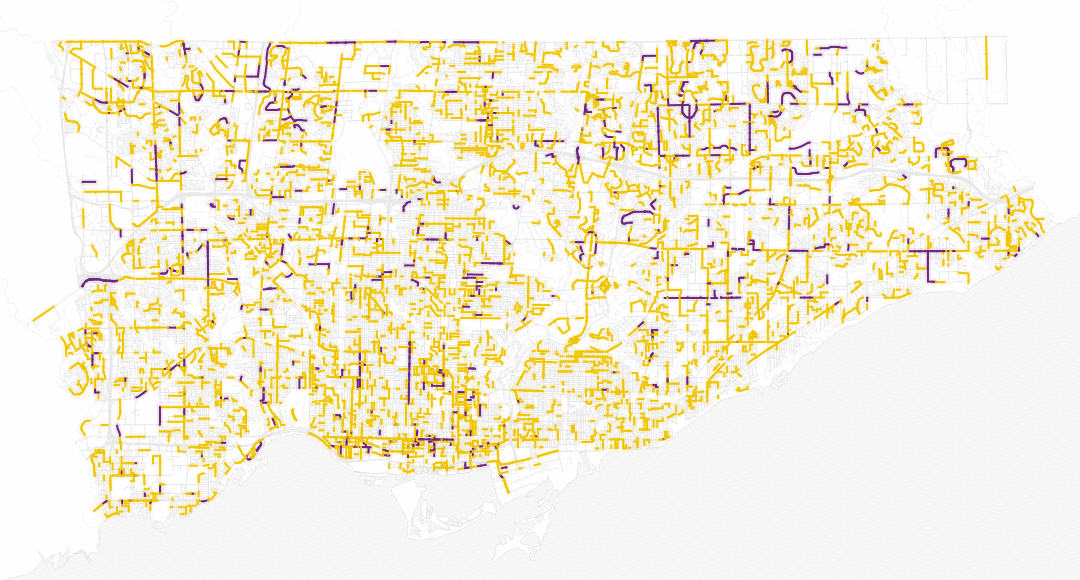
The City records permits to dig up or build in the public right-of-way (its streets and sidewalks), including who did the work, where, and when. Michel Mersereau, a researcher at the University of Toronto's Faculty of Information, obtained these records for 2012 to 2022 through a freedom of information request. The records list the streets where each company built. Mersereau's Broadband Infrastructure Market Insights project geocoded them onto Toronto's streets.
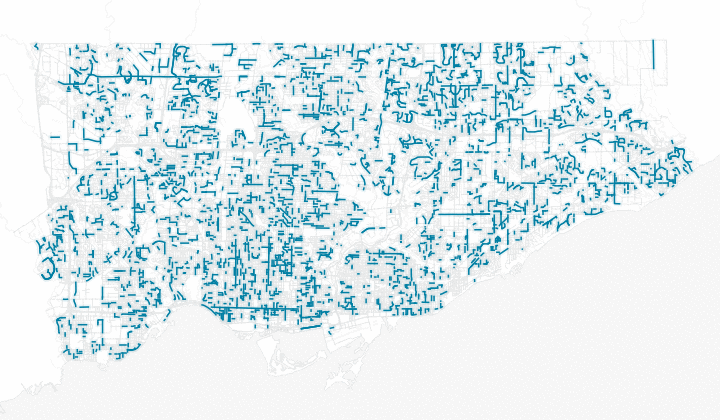
Most of this construction happened in a short period. Bell Canada's construction peaked in 2017, with 3,192 projects that year alone.
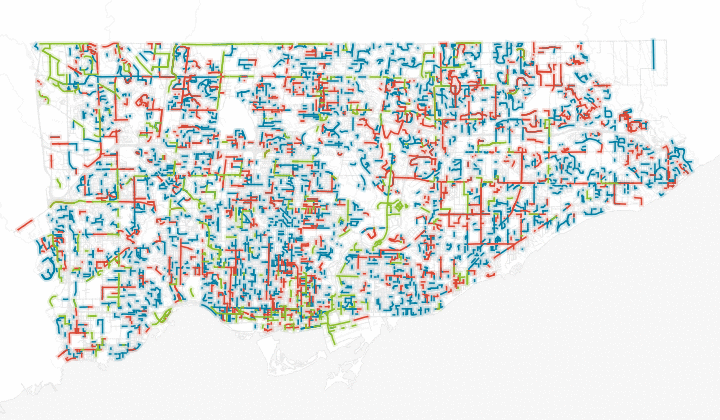
Matching the records of Bell and Rogers Communications by street and cross streets, Mersereau found that only about 12.5% of street segments had construction by both.
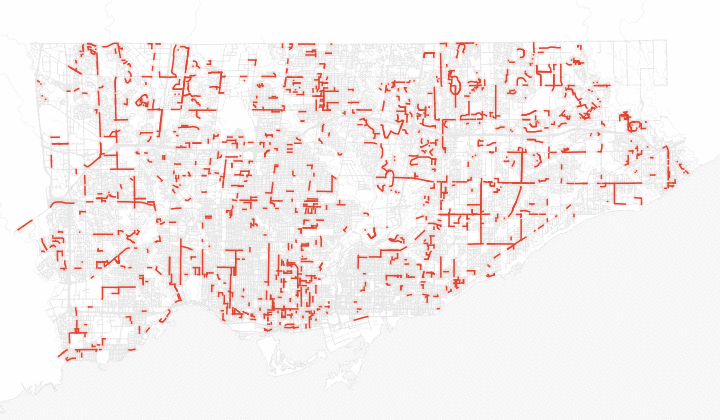
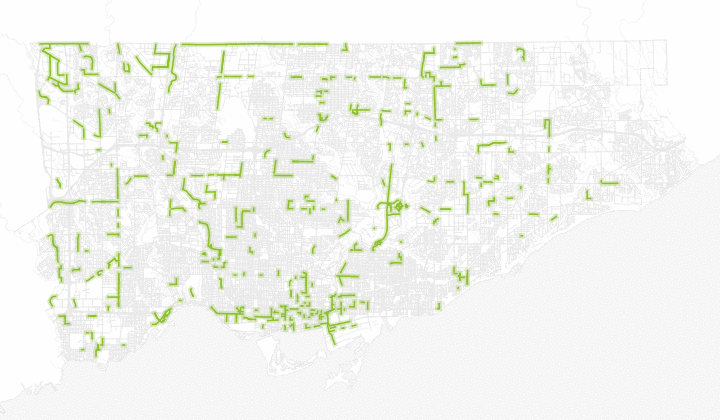
Mersereau reads this pattern as Bell and Rogers, the two largest providers in Toronto, avoiding head-to-head competition. This runs counter to the premise of telecom deregulation in the 1990s, that companies would compete by building their own networks. Bell expanded across many local streets, while Rogers and Beanfield, a smaller Toronto company, focused more on specific parts of the market, such as neighbourhoods with higher-density apartment and condominium buildings.
Mersereau's research also points to what competition, or lack thereof, can mean for prices. In a 2024 presentation to the City, Beanfield showed Bell's two gigabit fibre plans listed at up to $140 per month at Toronto addresses without Beanfield service, and at $60 per month at nearby buildings where Beanfield also offers service.
All of this construction occupies public land. Since a 2001 decision by the federal telecom regulator, the Canadian Radio-television and Telecommunications Commission (CRTC), and later changes to Ontario law, Ontario municipalities can recover the direct costs of telecom construction in their streets but cannot charge an occupancy fee for the space the infrastructure takes up. Mersereau argues this amounts to a public subsidy. Applying annual per-metre fees proposed or contracted in Canadian cities to the infrastructure built in Toronto from 2012 to 2022, Mersereau estimates an occupancy fee of about $75.8 million a year as of 2022.
Together, the City's records show that from 2012 to 2022, one company, Bell, did most new fibre construction, with little overlap between companies, under streets where no occupancy fee is charged. The City already collects these records as part of coordinating construction in its streets. The CRTC, asked for the same records, said it had none. Mersereau recommends that the CRTC collect this data from municipalities on a regular basis, both to track competition and to inform how the use of public space is valued. Without such data the regulator is "operating in a state of partial blindness."