This project is the first output of Hemmasi's research project "Keeping Kensington Market's Cultural Spaces," funded by a 2025-26 School of Cities Urban Challenge Grant on the theme of inequality, data, and democracy.
This project is a collaboration with the Kensington Market Community Land Trust (KMCLT), a community initiative created to protect Kensington Market's social and economic diversity by collectively purchasing properties for affordable housing, the maintenance of historical eclectic mixed-use neighbourhood profile, and the sustenance of socio-economically and culturally diverse residents and businesses.
Our project supports the KMCLT's initiative to collect and publicly share land and property use data within Kensington Market to help the organization expand their mission of "place-keeping."
What kind of market is today’s Kensington Market? What kind of market do Kensington Market community members want it to be? And how can data on neighbourhood change support Kensington Market’s communities’ desires to determine their collective future?
In this article we trace the changing commercial landscape of the market by enumerating the decrease of green grocers and primary produce vendors and the increase in cannabis dispensaries and other types of retail business. This visualized and mapped quantitative data provides a snapshot of the ever-changing Kensington Market and raises questions about how the commercial profile of a neighbourhood is both a reflection of and a contributing factor to its livability, affordability, place-making, and place-keeping.
In light of the accelerated change happening in the Market, our research team decided to generate data to quantify it. We believe in data as a tool for understanding the scale of these changes and advocating for policy or bylaw amendments that promote affordability and diversity within the commercial landscape of the market. With this data, KMCLT and other community groups can be better equipped to answer both the question of what kind of market they currently have, and what kind of market they would like it to be.
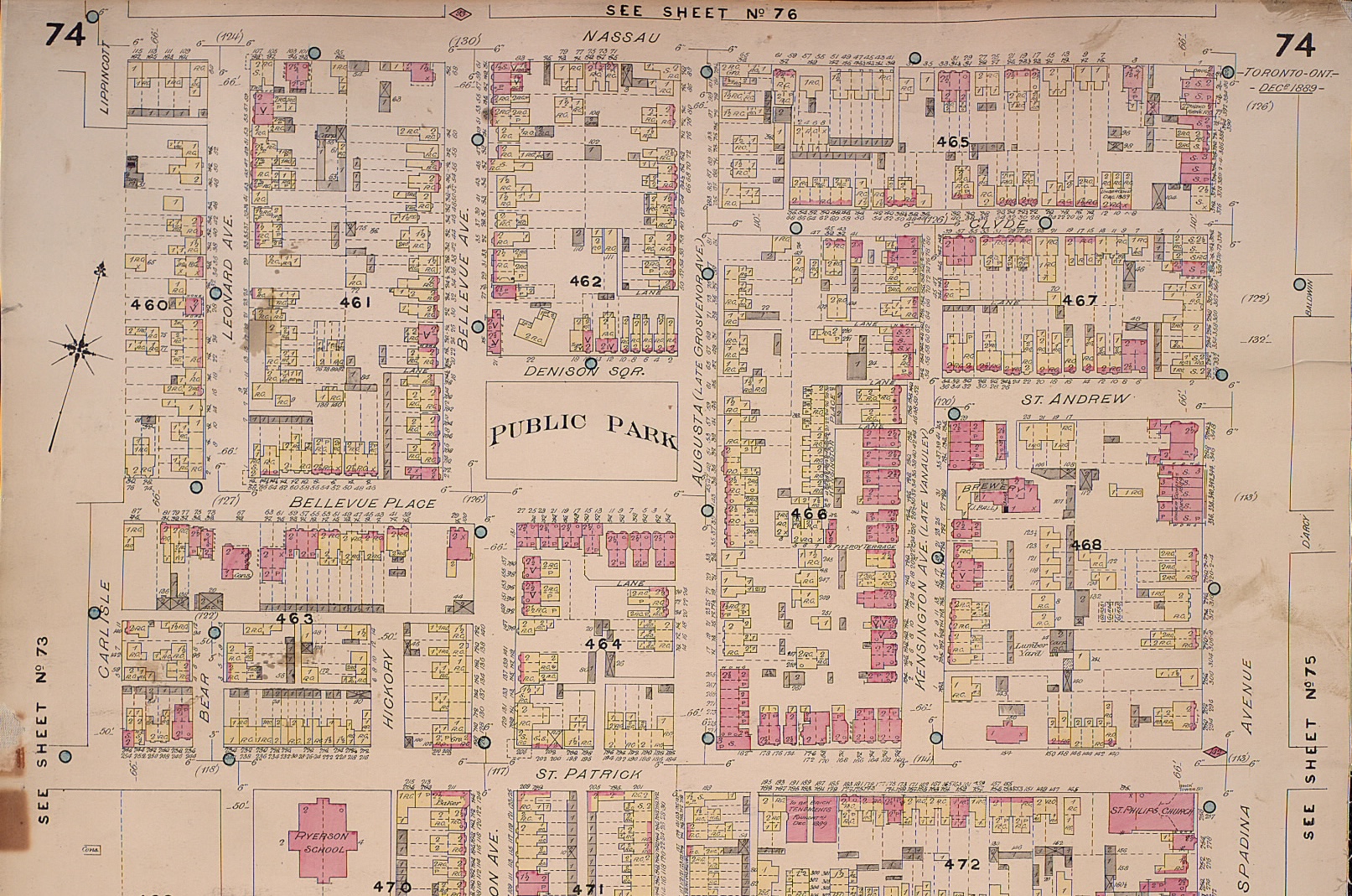
Toronto fire insurance plan covering Kensington Market. 1889.University of Toronto Map and Data Library.
Constant change in Kensington Market
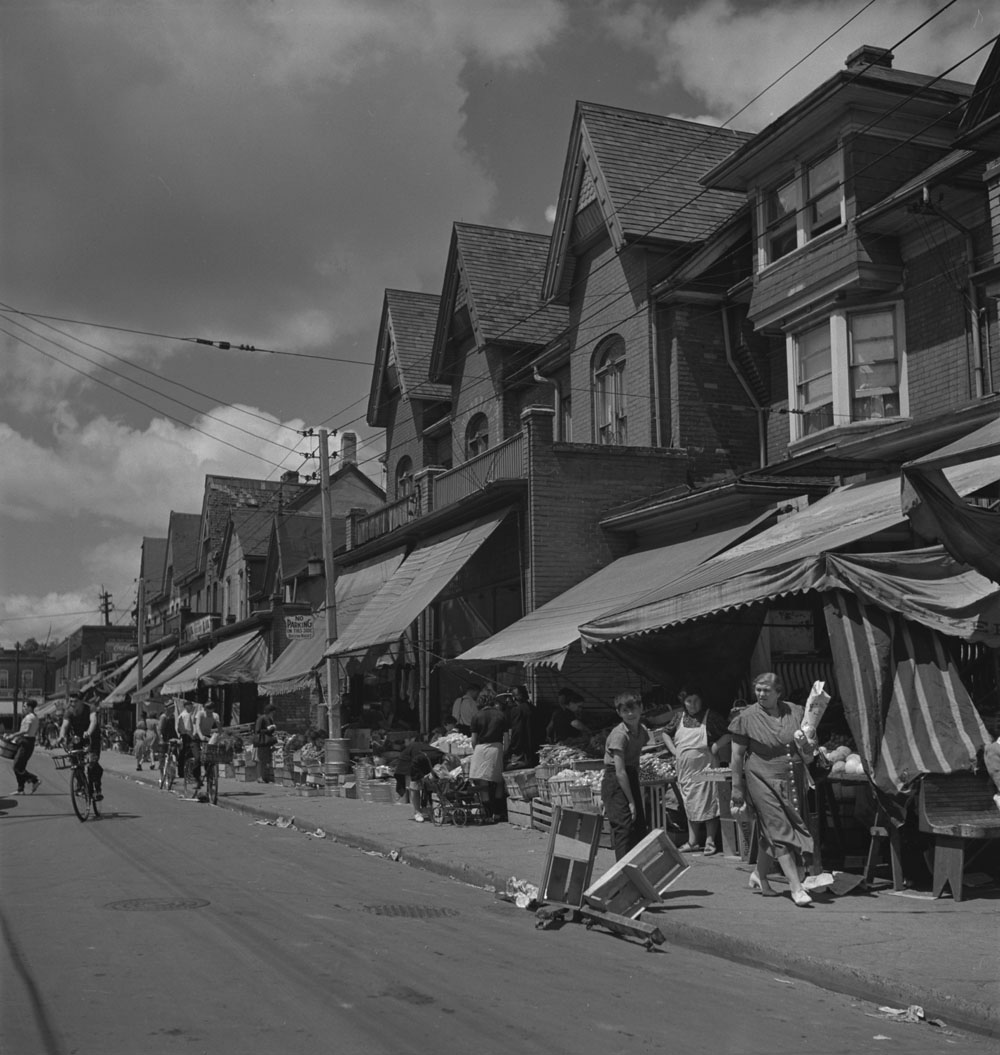
The Kensington Market of the mid-twentieth century was full of fruit and vegetable stands, butchers, bakeries, and dry goods stores. Images from the past vividly illustrate how each wave of immigrants established shops in the neighbourhood, catering to the food staples and tastes of their respective cultures, whether Jewish, Portuguese, Latin American, Jamaican, Chinese, and more. Elderly former residents and shoppers remember when Kensington Market was the kind of market with live chickens in cages on the sidewalk, which were slaughtered and defeathered on the street or in an alley (such as at Augusta Kosher Poultry and Meat Market at 253 Augusta Ave.); where bagels were sold on wooden rod by itinerant
Jewish bakers, and where one could find tropical fruits like those sold by Toronto’s first banana importer (Sanci’s Tropical Fruits) at 66 Kensington Ave.
Visiting Kensington Market today is a different, if no less stimulating an experience. A tour of the central Market streets in 2026 shows more restaurants, cafés, specialty stores, and cannabis retailers than green grocers and butchers. From one perspective, this is nothing new or noteworthy. As long ago as 1978, the City of Toronto Planning Study for Kensington notes a “decline of grocery and food sellers as an overall proportion of businesses within the Market…from 67% in 1964 to 39% by 1977.” [1] Surveying historical photographs of the neighbourhood confirms that this decline of grocers has continued.
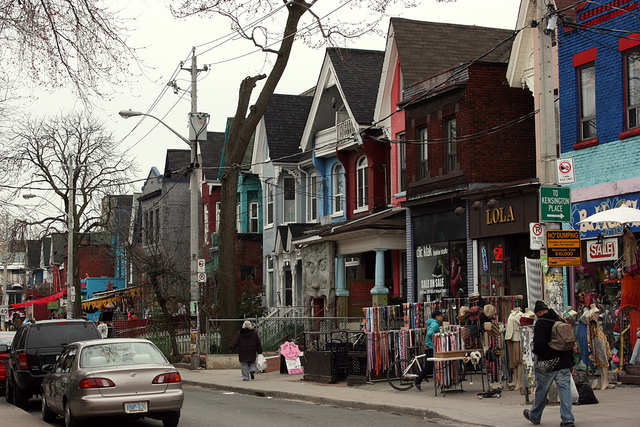
Street scenes in Kensington Market in the 1970s by Ellis Wiley.Source: City of Toronto Archives, Fond 124.
Change is a constant in urban centres, and Kensington is no different. But this particular change has met with strong reactions from inside and outside the neighbourhood’s boundaries. The decline of Kensington Market’s legacy businesses and food sellers is a recurring theme in local Toronto reporting, with scores of articles on this topic over the past decades. [2] The reasons cited for the change are diverse, from unaffordable commercial rents, changing patterns of immigrant entrepreneurship, and a different visitor profile with changing interests in goods and experiences.
A recent Toronto Life article quoted Kristin Donovan, the owner of Hooked seafood stores, who closed her Kensington Market storefront at 206 Baldwin St. in the summer of 2025. When she moved into the neighbourhood in 2012, Donovan felt optimistic about the Market as a food destination and confident in her business prospects, but she describes a neighbourhood transformed:
The tone of the market has changed. It seems to be mostly tourists and teenagers now, rather than the regular customers we had all grown used to. The neighbourhood is still cool and trendy, to be sure, and the energy is still great. But now people are just coming to walk around with a coffee instead of doing their groceries.They’re not looking to tote around a bag of fish. […] Recently, a lot of storefronts are up for rent, and the businesses that move in are hardly meeting the needs of the community: tattoo parlours, weed stores, mushroom dispensaries and restaurants that barely last a year. [3]
Donovan’s reference to commercial offerings in relation to “the needs of the community” is an important reminder that Kensington Market is and always has been more than a shopping district.
Since its beginnings, Kensington Market has been a residential neighbourhood – its residents currently numbering around 3,500 – whose occupants are among its stores’ primary customers. The historic combination of affordable rent and the availability of daily necessities close at hand is what attracted many current
residents to move to the area.
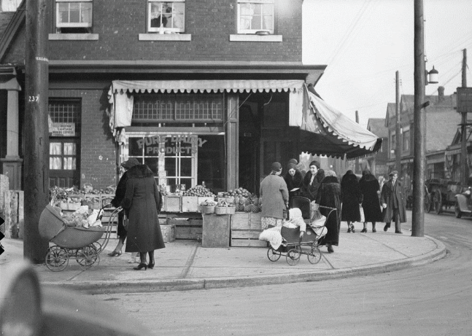
Augusta Ave. and Baldwin St. 1932.City of Toronto Archives.
Business and residential spaces are also physically intertwined. Especially on Kensington Ave., one finds many small businesses occupying the first floor of Victorian homes, a legacy of the neighbourhood’s historical pattern of setting up informal stores in street-level residences. Kensington Market is an unplanned, organically occurring mixed-use area “combining a broad array of residential uses, offices, retail and services, institutions, entertainment, recreation and cultural activities” within walkable distance – precisely the kind of urban land use the City of Toronto plans to invest in creating more of. [4]
More than goods and services
Kensington’s businesses offer their patrons much more than commodities and services. Over the years, its many community-serving businesses have simultaneously served as important sites of socializing, belonging, and care.
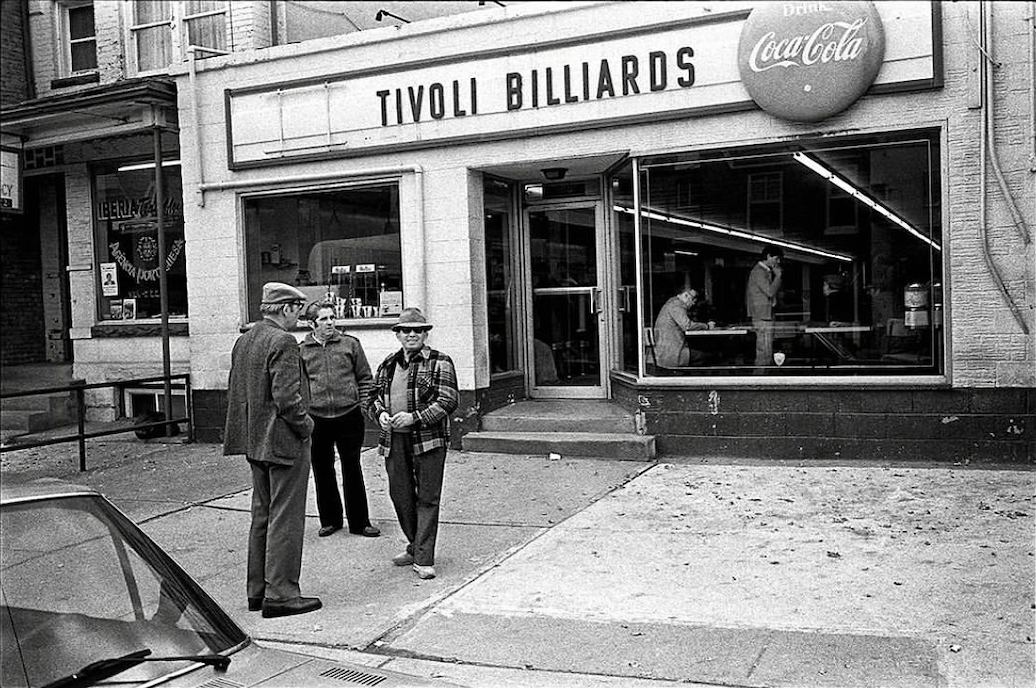
Tivoli Billiards 1960s.Avard Woolaver.
In the 1960s, Portuguese men seeking work would make their way to Tivoli Billiards Hall (264 Augusta Ave.) and Brazil Restaurant (61 Bellevue Ave.) places that were once “informal hiring halls.” [5] For nearly 50 years, Caribbean people in Toronto could find groceries and community at shop owner Yvonne Grant’s Caribbean Corner, still located at 171 Baldwin Ave. At 307 Augusta Ave., the café Pamenar has become one of the main gathering places for first-generation Iranian immigrants in the downtown core. The Portuguese bookstore at 86 Nassau St. was another important social meeting place. In Canadian popular culture, the CBC series King of Kensington was precisely about the social function of small immigrant stores: show protagonist Larry King was a variety store owner whose Kensington shop was one of several small business settings where locals found aid, information, and friendly conversation.
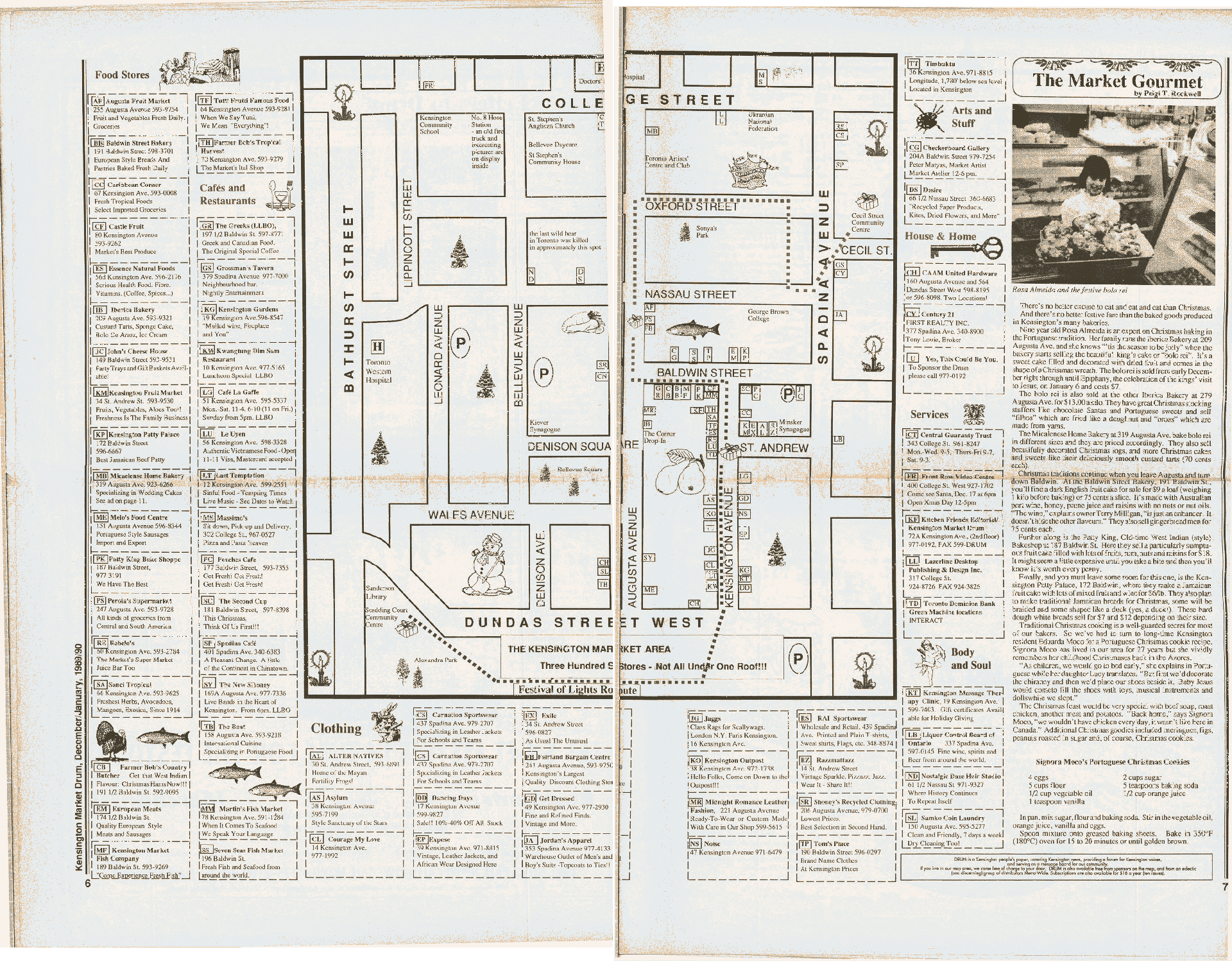
Map of businesses in Kensington Market from the 1980s.Kensington Market DRUM, December/January, 1989,1990.
The City of Toronto has prioritized small businesses in its recent economic strategy. Pandemic-era public health measures disproportionately affected small businesses, spurring targeted programs like Mainstreet Recovery and Rebuilding Initiative meant to help vulnerable businesses bounce back from this unprecedented challenge.
Writing of small businesses and their cultural and social contributions in Toronto’s Little Jamaica neighbourhood, urbanist (and Kensington Market resident) Jay Pitter states:
Local businesses—especially those tethered to racialized and newcomer communities—often bolster the economy, providing essential services such as the community provision of culturally desired foods and services. Also, many of these businesses serve as community hubs that provide informal mental health support, opportunities for intergenerational exchanges, safe(r) gathering spaces for youth, and compassionate mutual aid exchanges. [6]
Finally, the 2025-2035 City of Toronto Economic Plan presents the City’s intention to implement commercial rent control, small business tax relief, and other measures meant to “[ensure] Toronto’s unique small business districts are vital anchors for community activity, from commerce to civic engagement.” [7] The document lists Kensington Market as one of the small business districts the City’s measures are intended to protect.
While many community land trusts focus on housing affordability, the KMCLT has prioritized commercial affordability since its very beginning. KMCLT’s Dominique Russell comments, "We're looking at tracking commercial change because protecting the fabric of the neighbourhood is part of [KMCLT's] mission. Even as that fabric evolves, we still need community-serving businesses.” [8] Keeping Kensington Market affordable, livable, and diverse requires intervention and care on both residential and commercial levels. The organization articulates this perspective in its 2025 report on “place-keeping”:
When KMCLT emerged ten years ago, there was concern that rising commercial rents were making it impossible to sell raw foods, that the rents could only be afforded by bars and restaurants, and that Kensington would become a destination for tourists and Torontonians, but not for its residents, who are largely renters and lower income than the rest of the city. …An unfortunate consequence of this polarization of incomes and gentrification is a widening separation between the commercial and residential, in which the commercial no longer serves residents’ needs. [9]
Local independent businesses are often more vulnerable than their larger franchise competitors. While the pandemic period put exceptional stress on small businesses, the exponentially rising retail rents and building sales that preceded the pandemic and continue today are one of the most pressing challenges. For legacy businesses, second and third generations may not be interested in or able to continue the family trade. Changing patterns of entrepreneurship and immigration are all likely contributors.
Shop houses on Kensington Ave.Emily Hertzman.
In other cases, small business owners simply want a change.
In February 2026, Irene Morales, whose business Jumbo Empanadas opened in 1987, announced she was closing her shop. Although she owns the building in which her store is located, she cites rising costs, thinner margins, fewer customers since the pandemic, and her own aging as reasons for closing. In an interview with Toronto City News, Morales related that longtime patrons had begged her to stay open, but despite her feelings of guilt and the knowledge that her store would be missed, she chose not to continue. [10] She is now renting out her store. "I decided…I'm going to rent it out, because I'm getting sick, emotionally, mentally, physically, because of the stress. The stresses start to affect you.” [11]
Tracking shifts in businesses in Kensington Market
We compiled data from a variety of sources to verify and understand the scale of business type change in Kensington Market over time. [12] In July and August of 2025, we confirmed the presence of current businesses by walking through the Market, verifying and updating online data, and talking to market shop owners and residents. We then compiled historical business data from a series of older sources, including data collected by volunteers from the KMCLT and by members of the Kensington Market Historical Society. This was supplemented with Data Axle’s Canadian Historical Business Data (2009-2022), a large dataset that we refined and cross-checked against our other sources. [13]
We then developed a categorization system for present and past businesses and organizations according to types of goods and services found in Kensington Market:
Arts and performance: art galleries, studios, performance spaces, cinemas, recording studios
Medical: medical facilities, doctors' and dentists' offices, clinics, Toronto Western Hospital
Services: salons, tattoo parlors, car rentals and mechanics, laundromats, plumbers, banks
Social / community: houses of worship, non-profit social service organizations, community organizations and associations, schools and educational institutions
Foodstuffs: sellers of raw and dry goods, cheese shops, butchers, bakeries, fish sellers, spices, health food stores
Restaurants and bars: eat-in and take-out cafes restaurants and bars
Using this data, we chart the non-residential compositional makeup of Kensington Market. This shows a substantial increase in the proportion of restaurants and bars (from 21.3% in 2009 to 32.7% in 2025), a small increase in retail (from 27.6% in 2009 to 29.5% in 2025), and a marginal increase in arts and performance spaces (+1.3%). Declines are seen in medical services (9.3% in 2009 to 6.3% in 2025) and — most strikingly — the social/community and foodstuffs categories. Social and community land use in the Market decreased by 44% — from 8.7% in 2009 to 4.9% in 2025. Foodstuffs sellers showed the greater overall decrease, from 57 businesses (13.3%) in 2009 to just 26 (6.3%) in 2025 — a 53% decrease in 14 years. This is a considerable change from the historical concentrations of butchers, bakers, dairies, and primary produce vendors, located in the heart of the Market, and surrounded by schools, churches, synagogues, social clubs, and social service centres.
A closer look at the 2025 data reveals that Kensington’s
non-residential activity remains eclectic.
Of 410 locations surveyed, we found 121 retail locations, 134 bars and restaurants, 15 arts and performance venues, 26 medical service centers, 26 primary food sellers, 68 other types of service businesses, and 20 community organizations within its boundaries.
Food remains central to the Market’s commercial profile, but in 2025 it was prepared foods that were most plentiful. The number of dine-in and take-out restaurants, bars, and cafés accounts for 32.7% of commercial activity or 134 businesses. Put together, foodstuffs and restaurant/bars make up 39% of Kensington’s businesses.
Kensington Market’s retailers are diverse and numerous (121 or 29.5%), percentagewise nearly on par with the restaurants and bars (134 or 32.7%). The retail category includes a sizeable number of specialty stores (56) and vintage clothing stores (24). In 2025, discount stores, which were historically part of Kensington’s
commercial identity, make up just 12.4% of retail. The businesses identified as offering services, including 14 salons and 7 tattoo parlors, add to the commercial diversity and contribute significantly to the Market as a pedestrian destination.
Stores selling cannabis, mushrooms, and vapes collectively represent nearly 11% of all retail in Kensington Market and 3% of the neighbourhood’s overall non-residential activity. While cannabis legalization has played a role in this sector’s growth, the history of cannabis retailing in the Market precedes its 2018 legalization by several decades. Toronto’s very first cannabis consumption lounge HotBox (originally called Roach-o-Rama) opened in Kensington in 2000 and closed in 2022. As of 2025, there are 8 cannabis retailers in the neighbourhood.
The historic combination of affordable rent and the availability of daily necessities close at hand is what attracted many current residents to move to the neighbourhood.
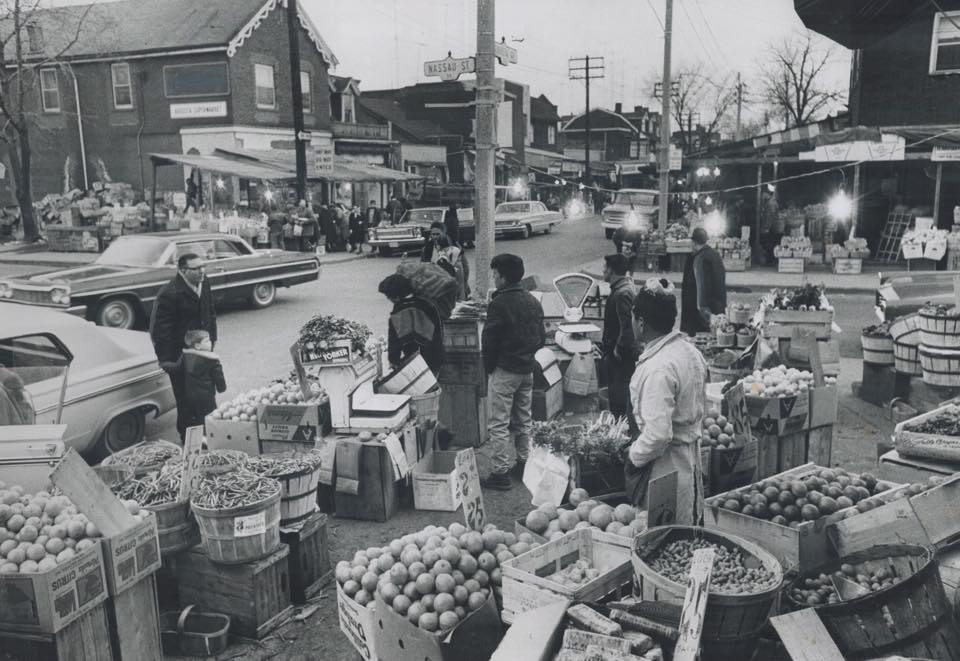
Nassau St. and Augusta Ave. in Kensington Market in 1966.Toronto Star.
What happened to the grocery stores?
Using a combination of KMCLT data and Google Maps Street View from 2007, we identified the names and addresses of all 31 grocers. We then compared this historical data with the businesses occupying those same addresses in 2025, representing continuity between past and present businesses with a solid line, and change with a dotted line. [14] Our data shows that only 11 of the 31 grocers remain open in 2025.
Mapping the disappearance of grocers since 2007
To convey the Market’s commercial dynamism, we created an
interactive map and timeline showing the change of grocers into other types of businesses from 2007 to 2025. The map consolidates multiple data points into a single framework.
To use the map, hold the curser over a coloured dot to see the changes in type of business over time at a specific location. Slide the timeline using the arrow to see the dots change colour indicating changes in the categorization of businesses over time. In the data summary at the top, are the number of losses and gains in each business category since the 2007 snapshot. A pop-up window on each map point displays a timeline for businesses occupying the selected address.
Conclusion
Our data indicate a clear and ongoing transformation in Kensington Market. Fresh food vendors and green grocers are declining in number, while prepared food establishments, bars, restaurants, and retail outlets now make up the majority of businesses in the area. We also note the reduction in community and social serving organizations. This shift reflects broader urban pressures — escalating commercial rents, rising property values, increasing costs of doing business intergenerational transfer of business, changing lifestyles and consumption habits, and more. Many of these challenges are also reshaping other Toronto neighbourhoods but are felt acutely by Kensington community members and observers alike.
In tandem with its rich and well-known history, Kensington Market’s small-scale, affordable, and village-like atmosphere in the centre of Toronto makes changes to the area feel more pronounced than in other areas. KMCLT’s work advocating for residential affordability to prevent the eviction and displacement of long-term low incomes residents, is part of resisting these urban development pressures.
However, there is an increasing awareness that commercial affordability is another key factor in keeping a neighbourhood liveable over a sustained time. Kensington Market has long had an identity as a market, a source of food for multiple and constantly evolving communities, not only for local residents, but for many groups of people scattered throughout the city to find specialty foods or less common cultural food items. That is changing now, as primary produce vendors shifts to prepared food.
In the course of researching this blog post, a new grocer emerged: on New Year’s Eve of 2025, Kensington restaurateur Ravi Ramoutar opened Kensington Vegetables and Flowers, a new produce shop at 274 Augusta Ave. The small shop has been eagerly welcomed by KMCLT’s Dominique Russell:
“The truth of it is Kensington is not going to have four green grocers or fruit stands on the corner again because shopping habits have changed…[b]ut any raw food seller that comes into the Market is a real win because it's not a vape shop, it's not a marijuana shop — it's something that really serves the neighbourhood. [15]
Unfortunately, just four months after opening and just as this blog post is going to press, Kensington Vegetables and Flowers has already shuttered its doors. The store’s short tenancy underscores our questions about the viability of small grocers in Kensington Market’s current economic conditions.
In 2025, the City of Toronto designated Kensington Market a Heritage Conservation district, preserving the built environment and recognizing that the Market’s “fine-grain commercial space has contributed to the concentration of independent businesses that support a sense of place and a uniquely animated public realm”. [16] While this designation acknowledges the historic importance of small business in the Market, without concrete economic policies, it is hard to imagine how small businesses such as green grocers can thrive, let alone survive.
In February 2026, the City of Toronto announced that it would lower small business property taxes, and its stated intention is to limit commercial rents by 2030, suggest the municipality’s willingness to take steps to lessen small businesses’ economic vulnerability.
The City of Toronto’s attentiveness to small businesses, and specifically to Kensington Market, is encouraging. But it takes time for their effects to be implemented and more time still for their impacts to be felt on the ground. Meanwhile, the Kensington Market Community Land Trust will continue to track, support, and advocate for Kensington’s small business community. We look forward to supporting them in this important effort.
Acknowledgments
We would like to acknowledge members of the Kensington Market Community Land Trust who have worked with us on this research, including Dominique Russell, Eugene Slonimerov, David Perlman, and many volunteers from the research committee. Serene Tan and Jeff Allen (School of Cities) provided suggestions and copy-edits to the text. Jeff Allen also supported web development for this project.
For this study, we consider Kensington Market’s borders as the south side of College Street, the east side of Bathurst, the north side of Dundas, and the west side of Spadina. See map below.
Data Axle, 2022, Canadian historical business data, https://doi.org/10.5683/SP3/IPKREG, Borealis, V8, UNF:6:4y7XObkF3X9gFP+CysA9yg== [fileUNF]. Accessed 19 February 2026.
We chose to use a solid line to represent the relationship between European Quality Meats and Sausages and its replacement Sanagan’s Meat Locker while different businesses with different owners, both are butchers.