Small, self-contained dwelling units built in the backyards of existing residential properties are growing in number in Toronto. These units are typically owner-led and can incrementally increase housing and density in a neighbourhood.
In Toronto, these units are often known as laneway suites when they back onto a public laneway, and garden suites otherwise. In other cities and planning contexts, similar housing is often referred to as accessory dwelling units (ADUs), backyard units, or rear-yard housing.
On this page, we query building permit data to track how many of these dwelling units have been built over time, and map where they are located.
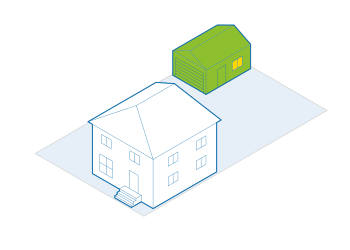
Converted garage ADU
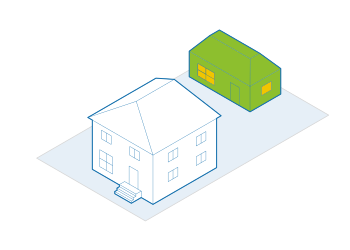
Garden suite
Toronto’s approach to permitting these units has expanded through the City’s Expanding Housing Options in Neighbourhoods (EHON) program, which is a broader set of strategies aiming to reduce exclusive zoning and increase density in residential areas. In 2018, these types of backyard units were permitted in parts of the former Toronto and East York District, limited to properties adjacent to laneways. This permission was extended city-wide in 2019 for all laneway-adjacent lots. In 2022, the City took a further step by allowing garden suites across most low-density residential zones, even where no laneway is present, significantly broadening where small backyard homes could be built.
Together, laneway and garden suites represent a form of gentle density: small-scale, incremental additions to existing neighbourhoods that do not substantially alter their built form. These units can provide rental income or flexible living arrangements for homeowners, support intergenerational households, and expand housing options for people who may not need or be able to afford larger homes. For cities facing housing shortages, they offer a way to add housing supply within established neighbourhoods while making more efficient use of existing land, parcel geography, and infrastructure.
A few years ago, we looked at both growth and decline of different types of gentle density in Toronto (including secondary suites and multiplexes), and also compared cities across Canada.
This page takes an updated and more in-depth look at laneway and garden suites using the City's building permit data. First we chart out trends of how many "New Laneway / Rear Yard Suite" have been built over time based on counting "closed" (i.e. completed) building permits in the data. We then chart out how many are currently active (i.e. have not been completed or cancelled) to show how many might be completed in the coming year or two.
Note that building permit data isn't a perfectly accurate representation of construction – there can be the occasional error in how the data are classified based on permit type, as well as varying lag when a project is complete and when the permit closes. However, it is probably the best open data we have to track this type of development.
621 laneway and garden suites have been completed in the City of Toronto from 2019 to 2025.
There are 986 in-progress laneway and garden suite building permits in the City of Toronto (as of 01/2026)
Note as well that not all issued and active permits will lead to completions. Likely some of those permits issued in earlier years may have stalled out, even if the permit is still active. As well, a number of permits (265 in total) were cancelled, and so are not included in our charts even though they were issued between 2018 and 2025. Based on these trends, it would be expected that up to 30% of the active permits in the chart above won't be completed.
Of those that are complete, the median time it takes from when a permit for a new laneway or garden suite is issued to when it is "closed" (i.e. complete) is just over 1 year (385 days), but this can vary quite a bit with approximately 15% taking more than 2 years.
Another question is where these housing units are built across the city. Development is constrained by residential zoning and historically, prior to 2022, by needing to be adjacent to a laneway. But beyond that, there is some variation in where units have been built, as well as in those that are in progress. Check out the map below to explore. Below the map is a time slider and layers to toggle what is being shown on the map.
Location of laneway and garden suites in the City of Toronto:
Permits completed by year
20182019 2020 2021 2022 2023 2024 2025
Active (in-progress) permits
Reference layers
Laneways
Permissible development areas (based on zoning by-law)
Income: Low
,
Medium
,
High
Data & Code
Data on the location, type, and status of building permits are from the City of Toronto's Open Data portal. To create these charts and maps, we filtered for all permits that were classified as "New Laneway / Rear Yard Suite" while being careful not to double count permits that had revisions. However, there may be some error if building permits were misclassified.
The residential zoning layer is also from the City's Open Data portal. The permitted zones are [R, RD, RM, RS, & RT].
The location of laneways is also from the City of Toronto's Open Data portal. It was filtered and extracted from the City's Centreline dataset.
The income data is from the 2021 Canadian census. The low category are census tracts with a median after-tax household income of less then $75,000, the medium range is between $75,000 and $100,000, and the high is above $100,000.
All code used to analyze this data and make this website and its graphics are on GitHub. It was built with the help of Python (pandas, geopandas), Svelte, Maplibre, pmtiles, and D3.

%20--%3e%3csvg%20width='20'%20height='20'%20viewBox='0%200%205.2916665%205.2916668'%20version='1.1'%20id='svg5550'%20inkscape:version='1.1.2%20(0a00cf5339,%202022-02-04)'%20sodipodi:docname='x-rearyard.svg'%20xmlns:inkscape='http://www.inkscape.org/namespaces/inkscape'%20xmlns:sodipodi='http://sodipodi.sourceforge.net/DTD/sodipodi-0.dtd'%20xmlns='http://www.w3.org/2000/svg'%20xmlns:svg='http://www.w3.org/2000/svg'%3e%3csodipodi:namedview%20id='namedview5552'%20pagecolor='%23ffffff'%20bordercolor='%23666666'%20borderopacity='1.0'%20inkscape:pageshadow='2'%20inkscape:pageopacity='0.0'%20inkscape:pagecheckerboard='0'%20inkscape:document-units='mm'%20showgrid='true'%20units='px'%20inkscape:snap-page='true'%20inkscape:snap-grids='true'%20inkscape:snap-to-guides='false'%20inkscape:snap-bbox='true'%20inkscape:zoom='22.292705'%20inkscape:cx='15.341342'%20inkscape:cy='14.960051'%20inkscape:window-width='1920'%20inkscape:window-height='1016'%20inkscape:window-x='0'%20inkscape:window-y='0'%20inkscape:window-maximized='1'%20inkscape:current-layer='layer1'%3e%3cinkscape:grid%20type='xygrid'%20id='grid7769'%20/%3e%3c/sodipodi:namedview%3e%3cdefs%20id='defs5547'%20/%3e%3cg%20inkscape:label='Layer%201'%20inkscape:groupmode='layer'%20id='layer1'%3e%3cpath%20style='fill:%23ffffff;fill-opacity:1;stroke:none;stroke-width:0.264583px;stroke-linecap:butt;stroke-linejoin:miter;stroke-opacity:1'%20d='M%200,1.3229167%201.3229167,0%205.2916667,3.96875%203.96875,5.2916667%20Z'%20id='path11500-7'%20sodipodi:nodetypes='ccccc'%20/%3e%3cpath%20style='fill:%23ffffff;fill-opacity:1;stroke:none;stroke-width:0.264583px;stroke-linecap:butt;stroke-linejoin:miter;stroke-opacity:1'%20d='M%201.3229167,5.2916667%200,3.96875%203.96875,0%205.2916667,1.3229167%20Z'%20id='path11500-3-7'%20sodipodi:nodetypes='ccccc'%20/%3e%3cpath%20style='fill:%23f1c500;fill-opacity:1;stroke:none;stroke-width:0.264583px;stroke-linecap:butt;stroke-linejoin:miter;stroke-opacity:1'%20d='M%200.52916666,1.3229166%201.3229166,0.52916666%204.7625,3.96875%203.96875,4.7625%20Z'%20id='path11500'%20sodipodi:nodetypes='ccccc'%20/%3e%3cpath%20style='fill:%23f1c500;fill-opacity:1;stroke:none;stroke-width:0.264583px;stroke-linecap:butt;stroke-linejoin:miter;stroke-opacity:1'%20d='M%201.3229167,4.7625%200.52916667,3.96875%203.96875,0.52916667%204.7625002,1.3229171%20Z'%20id='path11500-3'%20sodipodi:nodetypes='ccccc'%20/%3e%3c/g%3e%3c/svg%3e) Active (in-progress) permits
Active (in-progress) permits